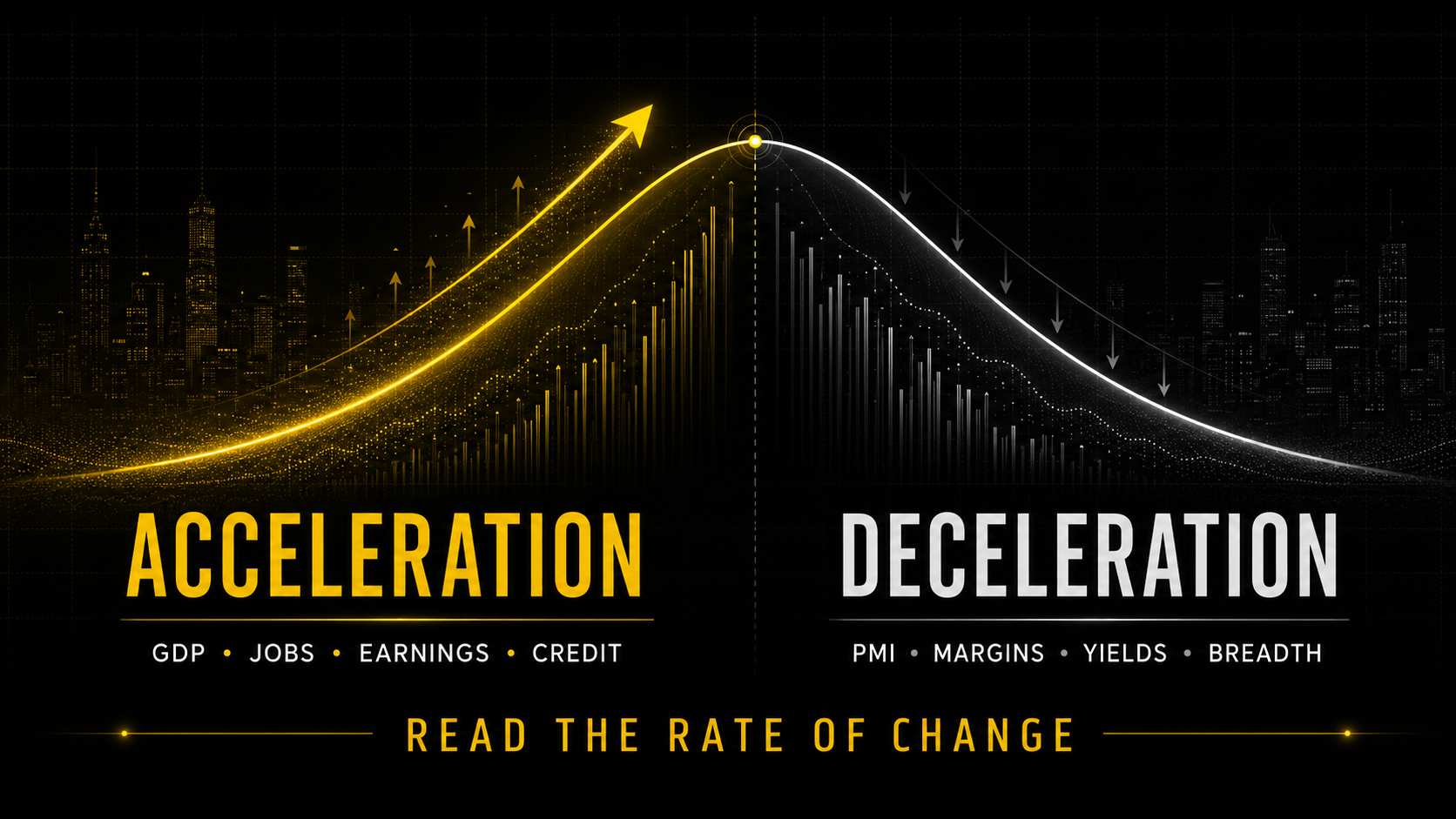
Markets rarely move in a straight line. They accelerate, lose momentum, reverse, and begin again. Recognizing these shifts is essential because asset prices often respond to the direction and speed of change—not simply whether the economy is growing or contracting.
Acceleration occurs when an economic or financial variable improves at an increasing rate. GDP may be expanding faster, corporate earnings estimates may be rising, or credit may be flowing more freely. Deceleration means the rate of growth is slowing. An economy can still be growing during deceleration; it is simply growing more slowly than before. Likewise, falling inflation represents price deceleration, not necessarily falling prices.
Several metrics help distinguish the two environments. Real GDP growth, payroll growth, unemployment claims, manufacturing and services PMIs, retail sales, industrial production, corporate earnings revisions, and lending activity reveal the economy’s momentum. Investors should also monitor market breadth, credit spreads, the yield curve, commodity prices, and the rate of change in inflation. No single indicator is sufficient. The strongest signal appears when several measurements turn together.
Acceleration was especially apparent during the recoveries following the 2008–09 financial crisis and the 2020 pandemic shock. After the pandemic contraction, reopening, fiscal support, low interest rates, and restored consumer demand produced an unusually powerful rebound. The Bureau of Economic Analysis estimates that real GDP expanded at a 4.5% annualized rate from the second quarter of 2020 through the first quarter of 2025. Employment, earnings, consumption, and asset prices advanced together, although not at identical speeds. BEA
Clear deceleration appeared during 2007–09, when housing, lending, employment, and economic output deteriorated. Another form emerged after inflation peaked in 2022. Consumer inflation reached 9.1% in June 2022, its highest twelve-month reading in approximately forty years, before slowing to 3.0% by June 2023. Prices were generally still rising, but their rate of increase had declined substantially. BLS
To ride an acceleration wave, favor areas demonstrating improving revenue, earnings, demand, and market participation. Add exposure progressively rather than chasing vertical price moves. Builders can increase marketing, inventory, hiring, and capacity—but only when customer demand validates expansion.
During deceleration, emphasize balance-sheet strength, cash flow, pricing power, and operational efficiency. Investors can reduce leverage, tighten risk limits, rebalance concentrated positions, and watch for companies whose fundamentals remain resilient. Builders should conserve cash, shorten feedback loops, renegotiate costs, and strengthen relationships with existing customers.
The critical skill is not predicting the exact peak or bottom. It is identifying when multiple indicators confirm that momentum has changed. Acceleration rewards participation; deceleration rewards preparation. Both create opportunity for people disciplined enough to read the rate of change, protect their rhythm, and move before the new environment becomes obvious to everyone.

Leave a Reply